Treatment of osteoarthritis in dogs: solutions to soothe pain and maintain mobility
CONTENT:
- Treatment of osteoarthritis in dogs: why can’t it be cured?
Stiffness upon rising, refusal to jump, unsteady gait: these are signs that should alert you. Your pet may be suffering from joint pain linked to osteoarthritis. This irreversible cartilage wear can be slowed down and relieved. What treatment is available for osteoarthritis in dogs? How can you tell if your pet is suffering from a joint or bone disorder? With the right veterinary care, low-intensity exercise and a healthy lifestyle, you can improve your arthritic pet’s everyday life.
Treatment of osteoarthritis in dogs: why can’t it be cured?
Osteoarthritis in dogs is a chronic, degenerative joint disease. It results from the gradual destruction of cartilage, the flexible tissue that absorbs shock between bones and enables friction-free movement.
Under the effect of time, overweight or trauma, this cartilage thins and then disappears in places. The bones touch, causing pain, inflammation and loss of mobility. The body tries to repair itself by forming new bone, osteophytes or “bone spurs”, which further distort the joint.
🐾 Remember:
Cartilage heals much slower than bone. There is therefore no cure for osteoarthritis, but it is possible to slow its progression and alleviate its symptoms.
Veterinary treatment of osteoarthritis in dogs aims at:
- reducing pain and inflammation;
- preserving mobility;
- maintaining the dog’s quality of life.
Early and regular care, combining veterinary care with a suitable diet and a healthy lifestyle, will enable an arthritic dog to remain active and comfortable for many years. Weight loss is often seen as the first step in alleviating osteoarthritis, even before considering a specific diet for arthritic dogs.
Among the natural solutions available, cannabidiol (CBD) is attracting growing interest for its potential soothing effect on joint pain. It can be offered as a supplement on veterinary advice.
🐾 Choking, heatstroke, sting/bite, seizures, etc. Francodex tells you about first aid steps that can save your pet’s life.
Dog breeds most prone to osteoarthritis:
Certain breeds have a genetic or morphological predisposition to developing osteoarthritis:
- large breeds, such as the Labrador Retriever, German Shepherd, Rottweiler, Newfoundland, Great Dane, etc.;
- sporting or working dogs, such as the Malinois, Border Collie or Golden Retriever, who are subjected to repeated joint stress;
- fast-growing breeds such as the Leonberger and Saint Bernard;
- breeds with a long back and abnormal leg conformation, such as the Dachshund or Basset Hound;
- more rarely, small breeds such as the Dachshund or Cocker Spaniel are sometimes affected by osteoarthritis of the spine.
How is osteoarthritis in dogs diagnosed?
Osteoarthritis in dogs develops gradually and insidiously. The first signs are often subtle: stiffness upon rising, mild lameness, reduced desire to move or difficulty climbing stairs. Early diagnosis can confirm the origin of the disorder, assess the severity of the injuries and provide appropriate care before the dog’s mobility is permanently impaired.
Clinical examination: the first step of a veterinary diagnosis
The vet always starts with a full musculoskeletal examination. They observe the gait, assesses the posture and palpates each joint to identify pain, heat or the range of motion loss.
This examination may be supplemented by flexion or extension tests to locate the faulty joint.
Depending on the results, the vet suggests a diagnosis of localised osteoarthritis (hip, elbow, knee, tarsus, etc.) or generalised osteoarthritis.
Imaging tests
X-ray remains the gold standard method to confirm osteoarthritis. It can highlight:
- joint space narrowing, a sign of cartilage loss;
- osteophytes (bony outgrowths);
- subchondral sclerosis (thickening of the bone beneath the cartilage);
- sometimes more advanced deformations.
In some cases, the vet may recommend:
- a CT scan to visualise fine structures;
- an MRI to study soft tissue (ligaments, muscles, joint capsule).
These tests can also differentiate osteoarthritis from other conditions such as septic arthritis or bone tumour.
CN and CT osteoarthritis:
A distinction is made between CN osteoarthritis (chronic non-inflammatory) with constant pain and no marked flare-ups, and CT osteoarthritis (chronic with inflammatory flare-ups) with alternating periods of calm and painful flare-ups. This distinction helps adjust the treatment.
Every 6 to 12 months, a regular veterinary check-up enables the protocol to be adapted based changes in the dog’s pain, weight and mobility.
How to relieve a dog with osteoarthritis?
While there is no cure for osteoarthritis in dogs, there are a number of solutions that can help slow its progression and provide lasting pain relief.
Veterinary treatments for osteoarthritis in dogs
Your vet remains your main contact when it comes to managing your pet’s osteoarthritis. They adapt the dog’s osteoarthritis treatment to its age, weight, the location and intensity of joint pain.
In most cases, non-steroidal anti-inflammatory drugs (NSAIDs) are the first line of defence. While they reduce pain and inflammation during flare-ups, prolonged use requires regular monitoring of the kidneys and liver.
Other drugs may be added to the treatment:
- pure analgesics, prescribed when pain becomes chronic;
- anti-NGF monoclonal antibodies, a recent therapy that blocks transmission of the pain signal.
In the most severe cases, surgery (arthroplasty, joint replacement, dysplasia correction) may be considered. This is a rare form of treatment for osteoarthritis in dogs, but it can sometimes restore the animal’s independence.
Osteoarthritis in dogs and life expectancy:
Osteoarthritis does not shorten a dog’s life span. What makes it worrying is the chronic pain it causes, which affects the animal’s daily comfort. Thanks to a comprehensive approach, the majority of dogs with osteoarthritis enjoy a long life. The prognosis therefore depends above all on the quality of care and the owner’s alertness to signs of discomfort. However, in the most severe and advanced cases, a dog that can no longer move because of osteoarthritis may have to be euthanised on veterinary advice and in consultation with the owner.
Weight control and diet
Being overweight is one of the major aggravating factors in osteoarthritis in dogs. Every excess kilo puts extra pressure on the joints and accelerates their deterioration.
Depending on your vet’s recommendations and your pet’s condition, a slight weight loss can significantly reduce the pain.
Diet therefore plays a key role in the treatment of osteoarthritis in dogs:
- reduced-fat kibbles are the best way to help your pet lose weight;
- “joint care” kibbles often contain omega-3, collagen and antioxidants and are best used when weight has stabilised;
- some formulations are enriched with glucosamine and chondroitin, two natural molecules that help keep cartilage supple;
- fish oils rich in EPA and DHA have been shown to have beneficial anti-inflammatory effects.
Opt for a balanced diet, formulated for your dog’s age and activity level, and above all follow your vet’s advice on adjusting feed rations.
In addition to standard dietary measures, certain dietary supplements can help boost your dog’s joint health.
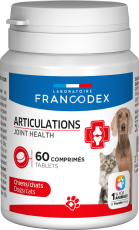
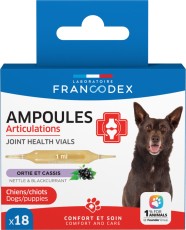
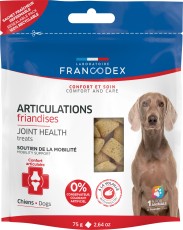
Francodex formulas, available in the form of treats, oral ampoules or tablets, combine natural active ingredients such as glucosamine and chondroitin. These nutrients support cartilage flexibility and help reduce joint stiffness on a daily basis.
-
Joint Health Tablets
Product info
Joint Health Tablets
Discover the product sheet " Joint Health Tablets ".
-
Joint Health Vials
Product info
Joint Health Vials
Discover the product sheet " Joint Health Vials ".
-
Joint Health Treats
Product info
Joint Health Treats
Discover the product sheet " Joint Health Treats ".
Physical activity and rehabilitation
Immobility accentuates stiffness, whereas movement, if well-balanced, combats it.
Short, regular walks, strolls on soft terrain, swimming sessions (except for elderly pets or those with a heart condition) or underwater treadmills are activities that maintain the muscles without putting stress on the joints.
In addition, functional rehabilitation (or canine physiotherapy) is the ideal complement to the treatment of osteoarthritis in dogs. It includes:
- circulation boosting massages;
- gentle stretching to maintain joint range of motion;
- hydrotherapy, electrostimulation, laser or ultrasound to relax muscles and stimulate tissue regeneration.
Each programme is tailored to your vet’s recommendations.
🐾 Is your pet getting on in years? Find out how to recognise and treat typical senior dog illnesses.
The daily life of an arthritic dog
Relieving osteoarthritis also involves simple everyday actions.
Give your pet a thick, orthopaedic bed that protects the joints while resting. Furthermore, slippery floors should be covered with non-slip mats, stairs replaced with ramps and repeated jumping avoided.
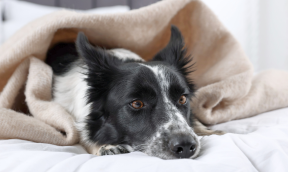
In cold or damp weather, a coat or heated blanket in a bed can soothe morning stiffness.
Last but not least, keep your dog’s spirits high. Sniffing games, quiet walks and the presence of its owner stimulate its overall well-being, which indirectly reduces pain perception.
When applied with consistency and care, these treatments truly transform the quality of life of an arthritic dog, enabling it to remain mobile, calm and happy despite the disease.
Article written with the assistance of
Dr Marie MAROSSERO, veterinary surgeon