Skin diseases in dogs: causes, symptoms and treatments
CONTENT :
- What are the most common skin diseases in dogs?
- What are the symptoms of skin disease in dogs?
- How do you treat a skin infection in a dog?
- What good practices will help to improve the condition of your pet’s skin?
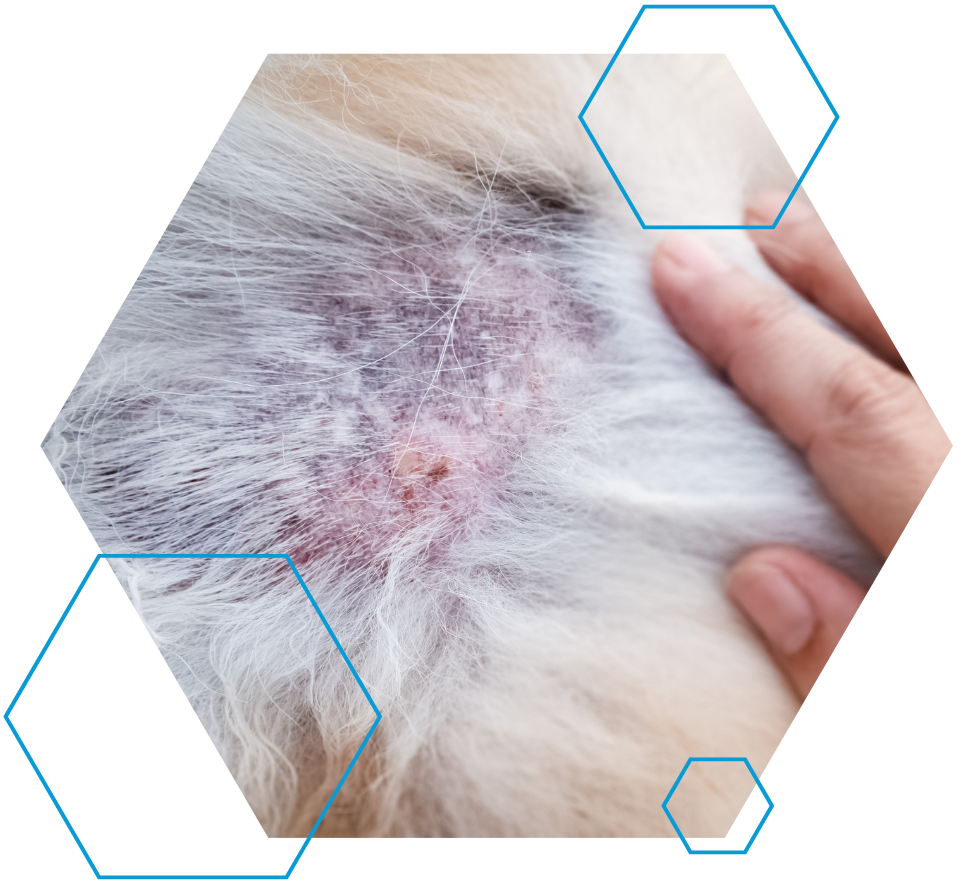
Constant scratching, hair loss or redness: skin diseases in dogs are common and are sometimes difficult to treat. Identifying the cause of your pet’s skin problem means you can begin the right treatment more quickly.
Taking care of your dog’s skin
What are the most common skin diseases in dogs?
Like human skin, a dog’s skin forms a protective barrier. If it’s weakened, a number of conditions can arise.
Atopic dermatitis or canine atopy
Of genetic origin, canine atopy is a chronic disease that is affecting more and more dogs, due to over-sanitised environments, food allergies and the ever-increasing number of pollutants in the atmosphere.
It should be noted that veterinary diagnoses are now also more reliable, as the various skin diseases affecting dogs are more easily identified.
Atopic dermatitis presents as a hypersensitivity of the immune system to environmental allergens such as pollen, dust mites and fleas.
The dog scratches intensely, especially around the ears, legs and belly. Secondary infections can occur if the skin is damaged by scratching.
Atopy requires long-term care, with regular treatment and appropriate hygiene.
Bacterial skin infections: pyoderma
Pyoderma are skin infections caused by bacteria, often Staphylococcus intermedius.
They cause:
- pustules;
- scabs;
- severe itching;
- weeping;
- an unpleasant smell.
Bacterial skin infections are often secondary to another condition, such as allergy, atopy or parasitic infestation. They require a veterinary consultation to determine the appropriate antibiotic treatment to administer, and/or whether to use a disinfectant shampoo.
Fungal infections: mycosis and ringworm
Mycoses are fungal infections, the most well-known of which is ringworm (Microsporum canis).
Highly contagious, including to humans, ringworm presents as circular bald patches, often on the head or legs. Mycoses can also affect skin folds or moist areas.
A precise veterinary diagnosis is essential if the right antifungal treatment is to be given.
Scabies (sarcoptic mange) and other skin parasites
Scabies is caused by a mite that is invisible to the naked eye, Sarcoptes scabiei, which burrows under the skin.
It causes intense itching, scabs and hair loss. Highly contagious between dogs and transmissible to humans, it requires treatment with a systemic antiparasitic medication.
In our part of the world, sarcoptic mange is very rare. Ear mites are more common.
Other parasites (Demodex, lice, fleas) can also cause irritation and skin lesions owing to an allergic reaction. Applying an external antiparasitic treatment will help reduce this cause of skin problems in dogs.
-
Dimethicone Anti-parasite Shampoo
Product info
Dimethicone Anti-parasite Shampoo
Discover the product sheet " Dimethicone Anti-parasite Shampoo ".
Hot spot: acute moist dermatitis
A hot spot is a type of pyoderma that appears suddenly: the skin becomes hot and red, weeps and causes the dog to scratch frantically.
These very painful lesions are often caused by a small wound or bite, which has been aggravated by excessive licking or scratching.
A veterinary consultation is required to determine the local anti-inflammatory and antibiotic treatment required. Shaving the area is essential.
Contact or food allergies
Food allergies, for example to beef protein, chicken protein, gluten, etc., can present as digestive problems, but also as chronic itchy skin.
Contact allergy, on the other hand, is caused by contact with an irritant (plastic, detergent, plant, etc.).
In both cases, identification of the allergen helps to suggest a suitable treatment, often by means of an elimination diet or allergy tests.
Autoimmune skin diseases: lupus, pemphigus
Autoimmune dermatoses are much less common and are caused by a disturbance of the immune system, which starts to attack the skin cells.
For example, pemphigus foliaceus causes scabs and blisters on the face, pads or ears.
These diseases require a precise dermatological diagnosis and an immunosuppressive treatment.
Hormonal disorders (hypothyroidism, Cushing’s syndrome)
Hormonal diseases can have an impact on the skin:
- brittle hair;
- symmetrical alopecia;
- darkened skin (hyperpigmentation);
- flaking;
- ect.
For example, hypothyroidism slows down the metabolism, which can result in dry, thickened skin and diffuse hair loss.
Conversely, Cushing’s syndrome causes an excess of cortisol in the body, making the skin thinner, more fragile and more prone to infection.
These hormonal disorders often go unnoticed at first, but specific blood tests can confirm the diagnosis and find a suitable treatment.
Seborrhoea: dry or oily seborrhoea
Seborrhoea, or seborrhoeic dermatitis, causes excessive production of sebum or keratin.
The coat becomes oily and has a bad smell and the skin gets covered in scales.
Some breeds, such Cocker Spaniels and Basset Hounds, are predisposed to this and can develop Malassezia (yeast proliferation) at the same time.
In such situations, regular topical care is needed (keratolytic or moisturising shampoos).
-
Nourishing Shampoo
Product info
Nourishing Shampoo
Discover the product sheet " Nourishing Shampoo ".
-
Shampoo Gentle and Moisturizing 250ml
Product info
Shampoo Gentle and Moisturizing 250ml
Discover the product sheet " Shampoo Gentle and Moisturizing 250ml ".
Skin tumours: epithelioma, mast cell tumours, etc.
Skin tumours are common skin diseases in older dogs.
Amongst the best known are epithelioma, a benign tumour of the sebaceous glands, and mastocytoma, a malignant tumour arising from mast cells.
Some tumours present as visible nodules or subcutaneous lumps, while others can be more difficult to detect.
A precise biopsy diagnosis will determine the nature of the mass and find a suitable treatment, which may be surgical, medicinal or palliative, depending on the stage and location.
Licking dermatitis (behavioural disorder)
Also known as acral lick dermatitis, licking dermatitis occurs when dogs lick themselves compulsively, often out of boredom or stress.
It causes a persistent sore, usually on the paws.
Treatment combines skin care, environmental modification and behavioural support, or even medication to treat the neurological aspect of licking dermatitis.
Dog breeds predisposed to skin problems: certain breeds have increased skin sensitivity due to their genetic heritage, or skin or coat structure. French Bulldogs, Shar Peis, Westies, Cocker Spaniels, Labradors, Boxers, Labrador Retrievers, Staffordshire Terriers, Bull Terriers and German Shepherds, etc. are amongst those most affected. In these dogs, skin folds, floppy ears and a fragile immune system are conducive to infections, allergies and inflammation. Extra vigilance and regular skin care help to keep their skin healthy.
What are the symptoms of skin disease in dogs?
There are certain signs that should alert you to the presence of skin disease in your dog. Here are the most common symptoms of skin problems in dogs:
- intense itching (scratching, biting, rubbing);
- localised or diffuse red patches;
- patchy or extensive hair loss (alopecia);
- visible crusts, scales or dandruff in the coat;
- weeping wounds or moist areas (hot spots);
- thickening or darkening of the skin (lichenification, hyperpigmentation);
- bad smelling skin;
- presence of pimples, nodules or lumps in/under the skin;
- compulsive licking, especially the paws or groin;
- sensitivity to touch or localised pain.
One or more of these symptoms warrants a rapid trip to the vets.
🐾 Discover our tips for looking after your dog’s coat.
How do you treat a skin infection in a dog?
When your dog has a skin problem, a veterinary consultation will establish a precise diagnosis with a clinical examination, and sometimes additional tests (skin scrape, cytology, allergy tests, etc.).
⚠️ The wrong treatment can make the problem worse or mask the symptoms without treating the cause.
Depending on the nature of the problem, there may be a variety of treatments available. Here are the main approaches used depending on the skin disease in question:
- oral or topical antibiotics and antiseptic shampoos for bacterial infections (pyoderma);
- local or oral antifungals and disinfection of the animal’s environment in the event of a mycosis (ringworm, yeast);
- regular internal and external anti-parasite treatments against parasites (fleas, scabies, mites);
- an elimination diet, hypoallergenic kibble, antihistamines or desensitisation to food or environmental allergies;
- corticoids, immunosuppressants and supportive dermatological care for autoimmune dermatoses (pemphigus, lupus);
- appropriate hormonal treatment (thyroid, adrenal) in the case of endocrine disorders such as hypothyroidism or Cushing’s syndrome;
- keratolytic skin care, sebum regulating shampoos and essential fatty acid supplements to combat seborrhoea;
- behavioural management, environmental enrichment, dressings or a collar in the event for licking dermatitis.
-
No-rinse Anti-itch Lotion
Product info
No-rinse Anti-itch Lotion
Discover the product sheet " No-rinse Anti-itch Lotion ".
-
Shampoo anti-itching 1L
Product info
Shampoo anti-itching 1L
Discover the product sheet " Shampoo anti-itching 1L ".


What good practices will help to improve the condition of your pet’s skin?
Even if certain skin diseases in dogs cannot be avoided, a healthy lifestyle can help protect your pet against some of them:
- give them a balanced diet rich in essential fatty acids (omega-3 and omega-6);
- use a gentle, moisturising shampoo or an anti-itch shampoo specifically suited to your pet’s skin type;
- brush your dog’s coat regularly to remove impurities and aerate the skin;
- apply a preventive pest control treatment throughout the year;
- avoid frequent bathing, which can dry out the skin;
- clean skin folds and ears in breeds prone to skin problems;
- reduce sources of stress and enrich your pet’s environment.
If your pet has a predisposition to the recurrence of certain skin problems, have its skin and coat checked regularly by your vet.
Taking care of your dog’s skin